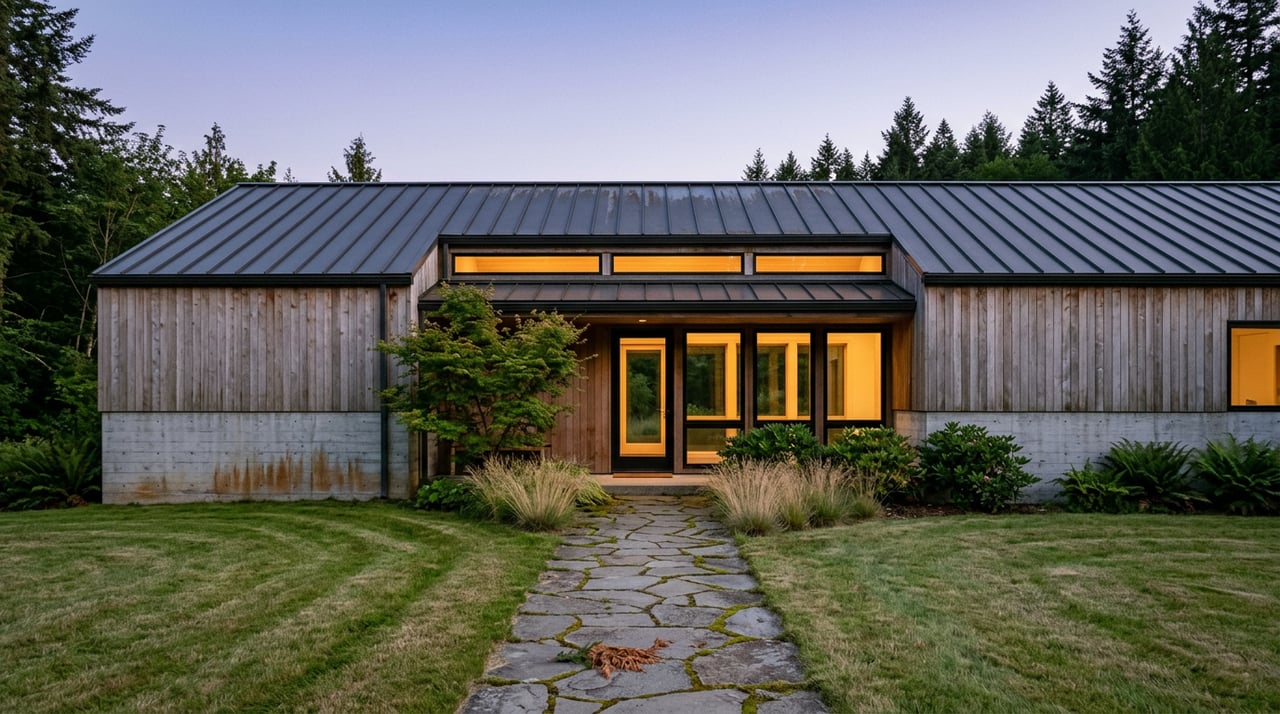
Carnation's Median Home Price Isn't Wrong. It's Just Averaging Two Different Markets.
September 17, 2026
September 17, 2026
Open two tabs on Carnation and you'll get two different towns. One tracker puts the median list price in July 2026 at $919,000, down 20 percent from a year earlier. Another, covering the same month, puts the town's overall home value at $1,004,023, down just 1.3 percent over the same stretch. Same zip code. Same month. An $85,000 gap in the headline number and a gap of nearly twenty percentage points in how much each source says values actually moved.
None of these sources made an error. They're measuring different things, and the gap between them is the most useful piece of information a Carnation buyer or seller can have this year.
A home value index and a median sale price are not the same instrument. An index tracks the estimated value of every home in town, whether or not it sold, and smooths that estimate month to month. A median sale price only counts the homes that actually closed that month, and in a small town, that's a short list. Carnation had roughly 8 homes sell in a recent one-month stretch. When your sample size is single digits, one $1.8 million farmstead closing instead of one $450,000 starter home swings the median by tens of percentage points without a single home actually losing value.
That's the mechanism behind the wild swings you're seeing quoted around town right now. The index barely moved because it's averaging across the whole housing stock. The monthly medians lurched because Carnation's housing stock isn't one market with some price variation. It's two markets, stitched together by a zip code, and which one happens to transact in a given month determines what the headline number says.
Carnation's median price isn't measuring a single market cooling or heating. It's measuring which of its two markets happened to sell that month.
The first market is the valley floor itself. Most of the land around Carnation sits in Rural Area zoning, much of it RA-10, meaning roughly one home per ten to twenty acres. That's not an accident of history. The zoning exists specifically to buffer the town's working farmland and forest production districts from residential encroachment, and it's applied even more tightly on parcels within a quarter mile of an active agricultural or forestry zone or a mineral extraction site.
You can see exactly what that produces in the land listings. A 10.48-acre parcel off West Snoqualmie Valley Road sold for $285,000 in May 2026, already carrying a completed critical area designation, power and telephone at the property line, and nothing else. Ten acres for that price sounds like a deal until you register what RA-10 zoning actually permits on it. You're not buying a subdividable lot. You're buying one homesite with a very large yard. Meanwhile, existing acreage estates in the same zoning class list as high as $1.875 million for a four-bedroom home on 20 acres, according to a local brokerage's own inventory description. Same rural zoning, wildly different price points, because the variable that matters isn't the land, it's what's already built on it.
This is the market that can pull a monthly median down hard one month and hand a chunk of it back the next, simply based on which two or three closings land inside that month's reporting window. Big lots. Big price range. Low transaction count. It doesn't move gradually. It jumps.
The second market is four city blocks wide and didn't exist five years ago. Three specific parcels along Tolt Avenue and its side streets were annexed into the city and rezoned from Light Industrial and Service Commercial designations into residential zones, R12 and R4, clearing the way for the first real wave of new construction Carnation has seen in a generation.
| Project | Former Zoning | New Zoning | What's Being Built |
|---|---|---|---|
| 85 Degrees (Pulte Homes) | Light Industrial / Service Commercial | R12 | 43 two-story townhomes, priced from the low $600,000s |
| Tolt River Terrace | Light Industrial / Service Commercial | R12 | 114 single-family lots plus 19 multifamily units proposed |
| Tolt Place | R4 (existing) | R4 | 12 single-family lots, subject to a 100-foot shoreline buffer from the Tolt River's channel migration zone |
85 Degrees is the furthest along, with model homes open and units already selling along Tolt Avenue in what Pulte describes as Carnation's historic downtown. Tolt River Terrace is still working through the city's development process, but the rezone that makes it possible is already recorded, and the city's own project tracker lists it alongside 85 Degrees and a handful of smaller infill applications. Tolt Place cleared its preliminary plat and shoreline permit review with the hearing examiner, with its buildable area carved to keep every lot outside the required buffer from the river's migration zone.
None of this is rural acreage. It's compact, walkable, and priced closer to what a move-up buyer expects from new construction anywhere else in East King County. It is also a genuinely small slice of Carnation's total inventory, which is exactly why one month it barely shows up in the sales data and the next month, if a cluster of these units closes together, it can pull the median toward the lower end all by itself.
If you're comparing Carnation to Duvall or Fall City on a portal, the median price column is telling you almost nothing useful about what you'll actually find on the ground. The real question is which of Carnation's two markets you're shopping in.
If you want acreage, privacy, and space for horses or a hobby farm, you're in the RA-10 market, where price is driven far more by what's already built on the parcel than by lot size, and where a critical area designation or an easement structure can matter more to your closing than the listing price. If you want new construction with a walkable Main Street a few minutes from the door, you're looking at a handful of units inside a rezoned pocket that didn't exist as residential land a few years ago, priced closer to what you'd expect in a denser Eastside suburb.
Sellers face the mirror version of this. If your property sits in the rural zone, comparing your asking price to last month's median is close to meaningless, because that median might have been set by a single farmstead sale or a single land parcel with no comparable improvements. If you're near the rezoned corridor, your competition is new construction with builder financing and warranty programs, not the neighbor's 15-acre lot down the road.
Either way, a single town-wide number can't tell you which situation you're in. A parcel-specific valuation can.
Does a 20 percent year-over-year drop in the median list price mean Carnation is now a buyer's market? Not necessarily. It means the mix of homes listed or sold recently skewed toward the lower end of the price range, which happens easily in a market with only a handful of monthly transactions. The town's broader home value index moved only slightly over the same period, which is a better signal of actual value trends than any single month's median.
Is new construction available anywhere else in the Snoqualmie Valley besides Carnation? Carnation is currently the site of the most active rezone-driven new construction in the immediate area, concentrated in the Tolt Avenue corridor. Other valley towns have their own inventory patterns worth a separate look if new construction specifically is the priority.
If I own rural acreage in Carnation, how should I think about pricing my home? Start with what's actually built on the parcel and its critical area status rather than the town-wide median, since RA-zoned properties don't behave like a typical subdivision comp set. A property-specific valuation accounts for the zoning class, easements, and improvements in a way a portal average cannot.
Carnation's numbers only look confusing until you know where to draw the line between its two markets. If you're trying to figure out which side of that line your own property or your next purchase falls on, Realtor Keren can walk through the specific parcel with you. Get Your Home Value and find out what your address is actually worth in a market that isn't as simple as the headline suggests.
Stay up to date on the latest real estate trends.
Dedicated to helping you find the right fit—with honesty, energy, and heart.